| 1. Meeting for Presenting Research Topics of NIAES
|
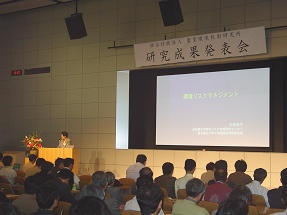
The Meeting for Presenting Research Topics of NIAES took place at EPOCHAL
TSUKUBA, the Tsukuba International Conference Hall, on April 23, 2002. It
was the first official lecture meeting held outside of the institute, commemorating
the first anniversary of the reorganization of the institute as an incorporated
administrative agency. The opening address was given by Katsuyuki Minami,
Director General of NIAES, followed by the special lecture, "Environmental
risk management" by Junko Nakanishi, Director of the Research Center for Chemical
Risk Management of the National Institute of Advanced Industrial Science and
Technology.
The following recent research topics of NIAES were presented: "Amounts of
greenhouse gas emission from agricultural land and technology for reduction
of the gas emission," "Prediction of the agricultural production change accompanying
global warming," "Environmental impact assessment of genetically modified crops," and "Present
situation of dioxins remaining in the agro-environment." In the overall
discussion, the last program, chaired by Executive Director Tsuyoshi Mitamura,
questions and answers covered such issues as the contribution of agricultural
activities to the reduction of greenhouse gas emission, safety evaluation of
genetically modified crops, and possible mixing of dioxins into agrochemicals
used formerly.
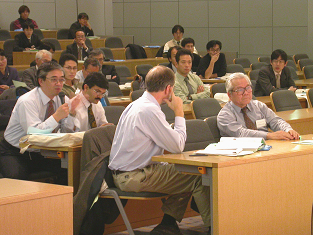
Attendants were 246 in total of 133 from outside of NIAES and 113 from the
institute. The questionnaire on this meeting gathered impressions and
opinions from about 100 attendants. The feedbacks were generally favorable,
for example, "Was good," "Topics were suitable," or "The presentations were
easy to understand," while some comments were critical, for example, "More
detailed presentations and discussion would have been expected," "Used too
many technical words," or "Supporting either the administrators or the producers
was not necessary." Other opinions, such as "I look forward to the next
meeting," and "Presentations of topics in other fields expected for future
programs," suggest major expectations by the general public to NIAES. The
meeting will take place every other year.
| Photo 1 Presentation of Research Topics at EPOCHAL TSUKUBA. |
|
|
|
|
| 2. |
International Workshop on Effects of Dioxins on Agriculture, Forestry and Fisheries and their Mechanisms of Action on Animals and Fishes
|
|
Dioxins have been known to be extremely toxic, persistent in the environment,
and bio-accumulative. Recently, dioxins, including Co-PCBs, discharged
into the environment are suspected of interfering with the endocrine systems
of organisms, even in extremely small quantities. To solve these serious
problems, the Japanese government initiated research programs under its Millennium
Project and an integrated research project, "Environmental Hormones Project," which
was conducted from 1999 through 2002 under the Ministry of Agriculture, Forestry
and Fisheries (MAFF).
The workshop, "Effects of dioxins on agriculture, forestry and fisheries
and their mechanisms of action on animals and fishes" organized in collaboration
with NIAES, MAFF, National Agricultural Research Organization, Forestry and
Forest Products Research Institute and Fisheries Research Agency was held at
the Tsukuba International Congress Center from December 4 to 6, 2002. Following
an opening address given by Dr. Minami, Director General of NIAES, 21
speakers presented topics on biological impacts and the fate of dioxins from
viewpoints of various research fields. There were 16 speakers from Japan,
2 from USA, 2 from Korea and 1 from Canada, and approximately 200 individuals
including other research institutions, universities and private sectors participated
in the workshop.
Participants exchanged information and discussed the results of the research
and future subjects of the study. The presentations can be categorized
according to the research topics of the dioxins. 1) Biological impacts: Seven
participants made presentations about contamination and biological impacts
of dioxins in wildlife and humans from Asia-Pacific and North America, and
bioaccumulation of dioxins in birds, fishes and animals. 2) Dynamics
in the environment: There were eight presentations on the levels and contamination
pathways of dioxins in air, paddy and upland soil, and plants such as rice
and vegetables, and on the risk assessments in Japan and Korea. 3) Degradation/Bioremediation:
To clean-up dioxin-contaminated soil and water, the effective technology using
biological and chemical degradation methods were discussed.
|
|
|
| 3. |
International Workshop on Material Circulation through Agro-Ecosystems in East Asia and Assessment of its Environmental Impact - Toward International Collaborative Research
|
|
A variety of materials has been circulating throughout the atmosphere, hydrosphere,
pedosphere, and biosphere in a sustainable manner. In the middle of the
20th century and onward, however, vigorous human activities have been disturbing
the sustainability of the material circulation, and brought about various ill-balanced
material flows, resulting in a rise in greenhouse gases (GHG), water shortage,
soil deterioration, natural resource exhaustion, accumulation of toxic chemical
substances, and a reduction in biological diversity.
East Asian countries, in particular, China, Korea and Japan possess a variety
of agro-environmental problems in common such as emission of GHG from farmland,
elevated CO2 affecting crop growth, pollution of soils and crops by heavy metals
and dioxins, deterioration of water quality, environmental risk of invader
species, and GMO and GM-crops. NIAES, the leading institute in agro-environmental
research in Japan has successively concluded a Memorandum of Understanding
with each of the National Institute of Agricultural Sciences and Technology
of the Rural Development Administration, Republic of Korea (2001) and the Institute
of Soil Science of the Chinese Academy of Sciences, the People's Republic of
China (2002) in order to enhance the three parties' research collaboration
on the common problems in agro-environments, and to work out better solutions
collaboratively.
As the first high-profiled step for the three-party research collaboration,
an international workshop on The Material Circulation through Agro-Ecosystems
in East Asia and Assessment of its Environmental Impact planned to share relevant
information regarding agro-environmental problems in East Asia, among top scientists
in China, Korea, and Japan. The workshop was held at EPOCHAL TSUKUBA,
Tsukuba, Japan on March 25-27, 2003, with 27 proposals from the countries under
the following 5 topics. Almost 150 participants joined this workshp (Photo). In
the workshop, participants discussed important common issues in agro-environment
in East Asia, and the feasible and effective schemes for collaborative research
to work out better solutions to mitigate the ill-balanced material cycle in
agro-environments and its environmental impact. The topics were as follows:
Topic A: Regional Agriculture and Environment in East Asia,
Topic B: Greenhouse Gas Emission and Sequestration in Agro-Ecosystem,
Topic C: Cycling of Farm Chemicals in Agro-Ecosystem,
Topic D: GMO & GMP, Bio-Remediation and Bio-Diversity,
Topic E: Construction of Environmental Resources Inventory and its Utilization
In the general discussion, the representatives from the therr countries pledged
future collaboration to cope with the current disturbing situations. Finally,
the chair proposed to hold the meeting in China in the following year. (Groupe
photo shoud be attached)
|
|
|
|