The mission of the Natural Resources Inventory Center is 1) to
perform fundamental research on the classification, identification,
characteristics, and functions of agro-environmental resources such
as soils, insects, and microorganisms; 2) to promote and support
research in these areas through collection, preservation, exhibition,
lending, and donation of specimens and samples; 3) to store all
agricultural environment information collected in databases and
to develop inventory systems that can be accessed with the aid of
tools such as the Internet; and 4) to collect and evaluate microbial
and insect genetic resources as a sub-bank under the MAFF Genebank
Project, in collaboration with related research groups.
The Natural Resources Inventory Center has 3 laboratories: Soil
Classification, Insect Systematics and Microbial Systematics. Each
laboratory has Soil Museum, Insect Museum, and Microbial Museum
respectively. In accordance with the NIAES mid-term research plan
formulated in FY 2001, these laboratories have carried out the following
research: 1) classification and elucidation of the functions of
soils, and construction of a framework for a soil inventory; 2)
construction of a database for type specimens of insects, and construction
of a framework for an insect inventory; 3) classification and identification
of microorganisms co-inhabiting gramineous plants, analysis of their
functions, and construction of a framework for a microorganism inventory;
and 4) collection and evaluation of microorganism and insect genetic
resources. Major topics in 2002-03 are described in the Topics that
follow.
Dr. S. Yoshida, researcher in Microbial Systematics, received an
award from the Phytopathological Society of Japan for his contributions
on mulberry anthracnose.
Topic 1: New evidence of damage by 3 noctuid (Insecta: Lepidoptera)
pests in mainland Japan
The provision of a service for the identification of insects for
scientific study, pest management, and human health is one of the
important tasks of the Insect Systematics Laboratory. There are
many requests for identification every year from agencies and companies
in Japan.
Mainly as a result of insect identification requests from the agricultural
experimental stations and plant protection offices of several Japanese
prefectures, we recently discovered new evidence of damage caused
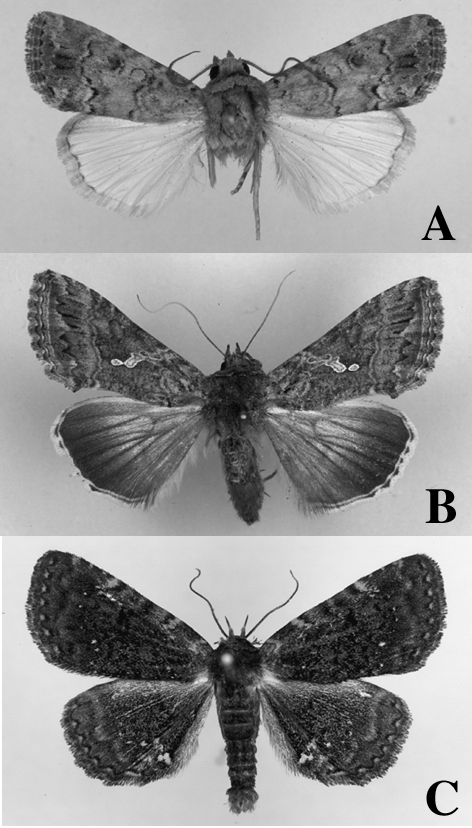
by 3 noctuid pests: Spodoptera cilium, Trichoplusia ni, and Diomea cremata.
Spodoptera cilium (Photo
1A) is distributed in the tropical and
subtropical regions from Africa to Asia and the Pacific islands.
In Japan this species was previously known to be distributed only
in the Ryukyu Islands and the Ogasawara Islands. Although a few
adults were collected from Kumamoto and Hyogo Prefectures in 1994,
no damage of plants by this species had been reported in Japan.
However, since 1999 we have found severe damage by this species
to the turf grasses of golf links in Shizuoka Prefecture.
Trichoplusia ni (Photo
1B) is a worldwide notorious pest and causes
damage to many vegetables and crops. This species was known to be
distributed in Japan but had not previously been recorded as a pest
here. In Hyogo Prefecture we recently observed pest populations
of this species and damage to many vegetables, including crucifers.
Diomea cremata (Photo
1C) had not previously been recorded as a
pest of cultivated mushrooms, but we have observed that this species
feeds on the shiitake mushroom, Lentinula edodes, cultivated on
synthetic logs (composed mainly of sawdust), which have replaced
natural logs over the last decade. The larvae usually consume the
thick brown mycelial coat formed on the surfaces of synthetic logs
and sometimes eat the fresh fruit bodies.
We plan to construct an insect inventory in which we will accumulate
information on insects associated with the agro-environment. Our
pest identification services not only give practical help to farmers
but will also contribute to the development of this inventory. (S.
Yoshimatsu and K. Yasuda)