The Chemical Analysis Research Center consists of 2 laboratories.
The mission of the Environmental Chemicals Analysis Laboratory is
the development of rapid and highly precise methods for the analysis
of dioxins, pesticides, and endocrine disrupters such as nonylphenols
and heavy metals, and for elucidation of the behavior and pathways
of chemicals in the agricultural environment. We have developed
methods for the simultaneous determination of 15 sulfonylurea herbicides
and the rapid screening of metalloproteins (Topic 1). We are also
studying enzyme-linked immunosorbent assay of nonylphenols.
The Radioisotope Analysis Laboratory has been measuring the radioactivity
of artificial and natural radioisotopes such as 137Cs and 90Sr in
wheat, rice, and soil since 1957. The other research objective of
this laboratory is the development of a rapid and highly accurate
method for the analysis of agro-environment elements by using radiation,
and elucidation of the dynamics of radionuclides and relation nuclide
(Topics 2 and 3).
Dr. Eun Heesoo, a researcher at the Environmental
Chemicals Analysis Laboratory, was awarded a "Gratitude Plate" by
Chung Moo-Nam, administrator of the Rural Development Administration
of the Korean Government, for his outstanding contributions to
the advancement of agricultural research and development.
Topic 1: Rapid screening of metalloproteins by LA-ICP-MS combined
with Native-PAGE
About one-third of all proteins contain metal ions such as calcium,
iron, zinc, and copper and are therefore called metalloproteins.
Most metalloproteins play important roles in biological activities
as enzymes, and some of them facilitate the detoxification of toxic
metal ions such as cadmium and mercury. To understand the structure
and function of metalloproteins, we need to develop analytical methods
that have high resolution for proteins and high sensitivity for
metal ions. For this purpose we trialed a combination of native
polyacrylamide gel electrophoresis (Native-PAGE) and laser ablation
inductively coupled plasma mass spectrometry (LA-ICP-MS). Standard
metal-containing proteins - horse ferritin, bovine catalase, bovine
albumin, egg albumin, cytochrome C, rabbit metallothionein, and
keyhole limpet hemocyanin - were separated by using Native-PAGE.
After staining with Coomassie blue, the gel was dehydrated by soaking
in ethanol-water solution. The volume percentage of ethanol was
raised stepwise from 50% to 100%. The shrunken gel was air-dried
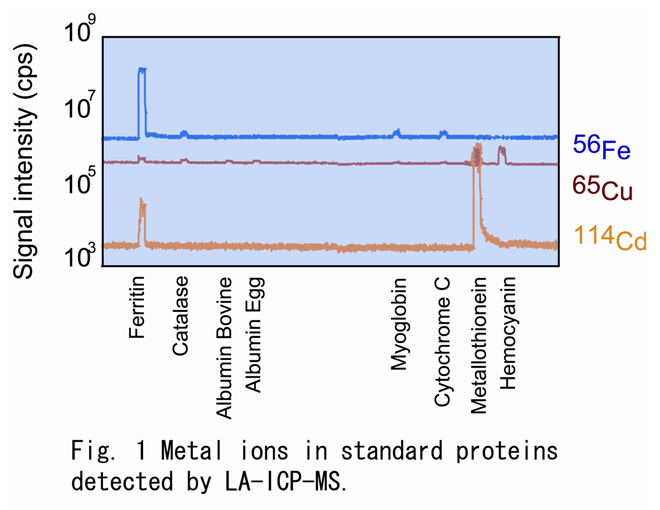
and the metal ions were analyzed by LA-ICP-MS. Metal ions were detected
accurately in all the standard proteins (Fig.
1). Furthermore, unexpected
metal ions such as cadmium in ferritin were detected. This method
could be useful for rapid screening of various metal-containing
proteins and their mixtures. (K. Baba)
|
Topic 2: Assessment of desertification from soil concentrations of radioactive nuclides
In recent years, overgrazing and excessive cultivation have been causing
desertification in the grasslands of China's Inner Mongolia Autonomous
Region, and this has become a grave problem. The purpose of this research
is to develop techniques to assess surface erosion from the concentrations
of radioactive nuclide fallout in soil. We studied a new technique that
uses the naturally occurring radioactive nuclide 210Pb. This nuclide belongs
to the uranium series and is produced by the disintegration of 238U in
rocks and soil, through the intermediate forms 226Ra and 222Rn:
| |
238U |
----> |
226Ra |
----> |
222Rn |
----> |
210Pb |
----> |
206Pb |
| Half-life: |
|
4.5 billion years |
|
1600 years |
|
3.8 days |
|
22.3 years |
|
These nuclides are in radioactive equilibrium, so the ratios of their
remaining amounts are constant. However, the rare gas 222Rn comes between
226Ra and 210Pb, and this nuclide disperses from the soil into the atmosphere,
although in small ratios. This dispersed 222Rn disintegrates into 210Pb,
which then falls to earth, where it accumulates when fine soil particles
adsorb it. We marked off areas of grassland as test areas in which we
controlled grazing and investigated the relationship between the concentration
of fallout 210Pb radioactivity in the soil, the topographical conditions,
and the grazing pressure.
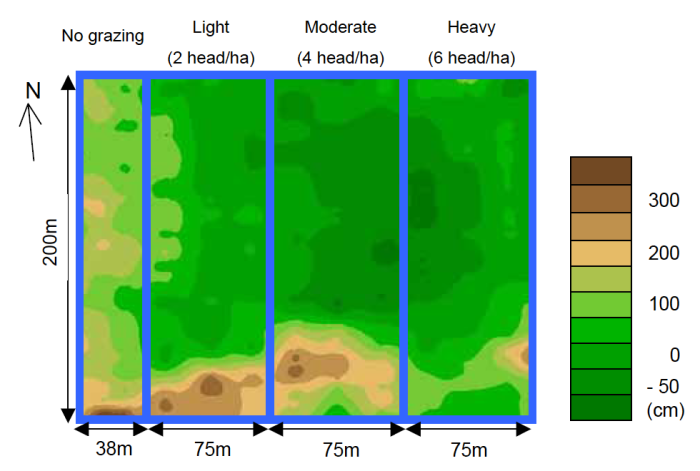
Figure 2 shows the shapes of the test zones and their elevation distributions
from the survey results. Although the topography was more or less flat,
the southern parts were a little higher, and we found a maximum elevation
difference of about 3 m within the entire test area. Different grazing
densities were set for each zone, and sheep were continually pastured
there from 1992 to 1996. In 1998 we took samples of the soil down to a
depth of 5 cm at several locations in each of the test zones. After drying
the samples, we measured their gamma radiation with a germanium semiconductor
detector to find their radioactivity concentrations.
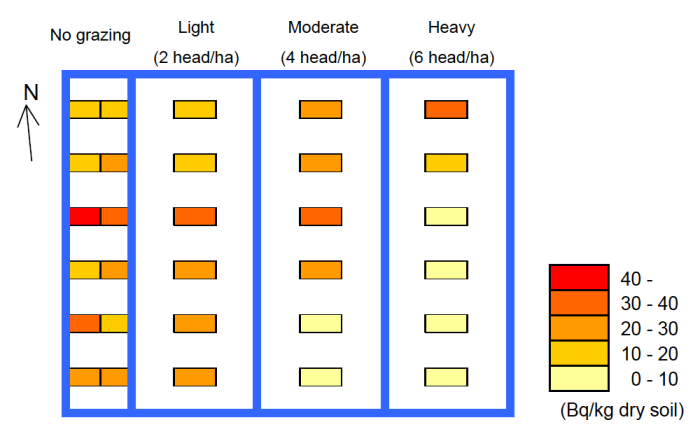
Figure 3 shows the distribution of fallout of 210Pb radioactivity in
the soil of the test grazing zones. We compared the grazing zones and
discovered that the higher the grazing density and the greater the degradation
of vegetation by grazing, the more locations we found with low 210Pb radioactivity
concentrations. Bare land appeared on the hillocks, where the elevation
was higher, and locations with low 210Pb concentrations were also distributed
mainly among the hillocks. Therefore, this method of estimating the extent
of erosion by using fallout of 210Pb in the soil as an indicator is useful
for assessing desertification, and is promising for applications such
as judging the risk of desertification and confirming the effectiveness
of afforestation and other remedial measures. (H. Fujiwara)
|
| |
| |
Topic 3: Comparison of vertical distributions of iodine in soils of a paddy field, an upland field, and a forest plot
Iodine is an essential component of thyroid hormones, and about 200 million
people worldwide suffer goiter because of a deficiency of this element.
Iodine, however, is highly toxic to higher plants. The Chernobyl disaster
of 1986 sent large quantities of 131I (half-life 8 days) streaming into
the environment. Further, 129I (half-life 15.7 million years) can be released
from nuclear fuel reprocessing facilities, so it is important that a 129I
monitoring system be installed in the facility under construction at the
village of Rokkasho, Japan.
To study the fate of iodine in the environment, we considered the vertical
distribution of iodine in the soil to a depth of 50 m in a paddy field,
an upland field, and a forest plot situated in a diluvial upland at NIAES.
The soil iodine concentrations to 2 m ranged from
forest plot > upland
field >> paddy field. In the upland field, the iodine concentrations
(in mg kg-1 dry weight) of the surface layers and the next layer (the
Ap1, Ap2, and 1A1 horizons, 0-30 cm) were the highest (42-44), and in
the forest plot the iodine concentrations of the surface layers and the
next layer (Ap, A, and AB horizons, 0-29 cm) were the highest (65-71).
In the paddy field, the surface layer (Apg horizon, 0-18 cm) (the most
reducing horizon), was eluvial with regard to iodine and featured a low
content of 2.8; the iodine concentration (5.3) of the slightly oxidizing
Bg1 horizon (18-36 cm) was higher than that of the surface layer, and
the iodine concentration (12) of the 2Bw horizon (60-89 cm), which lacked
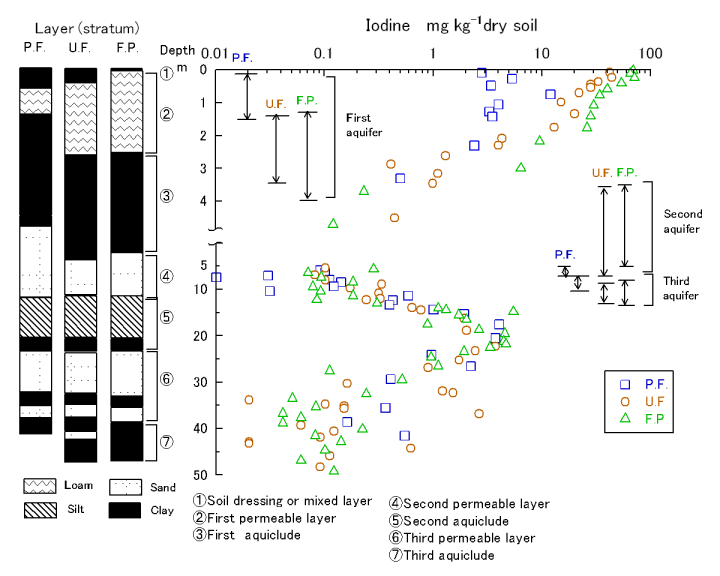
gleyzation, was highest. From the depth at which the first aquiclude (composed
of heavy clay) appeared, to the depth at which the second aquifer (composed
primarily of sand and fine sand) appeared, the iodine concentration rapidly
decreased to very low level of around 0.1 on 3 sampling locations. There
was little difference between the 3 sampling locations in terms of the
zones at, and beneath, the reductive second permeable layer, situated
below the water table (Fig. 4). In the second aquiclude, which contained
mostly clay and silt, the iodine concentration increased with depth and
reached 5 mg kg-1 on 3 sampling locations. The layers from the third permeable
layer to the third aquiclude were more reducing and had a higher pH, which
promoted the elution of iodine at levels ranging from 0.02 to 1.0. There,
the iodine level on 3 sampling locations was low, and there was little
difference between the levels in the permeable portions and those in the
third aquiclude. These results are useful for forecasting the behavior
of radioactive iodine in the environment. (N. Kihou)
|
|
|
|