| 1.
|
Elucidation of Global Warming Impacts in Agriculture, Forestry and Fishery and Development of Mitigation Techniques
|
The Council of Science and Technology Policy
in the Cabinet Office has set out the "Promotion Strategy of Priority Fields" in 2001,
in accordance with the "Basic Plan for Science and Technology, " which
is now in the second phase in the fiscal years 2001 through 2005.
The Council of Science and Technology Policy has organized the "Research
Initiatives" in the field of environmental studies to comprehend
and integrate the research activities that have been conducted under
the auspices and the directions of many ministries and agencies in
Japanese government. One of the progressive research initiatives
in the field of environmental studies is Global Warming Research
Initiatives.
A comprehensive research was initiated in 2002 coordinated by the
Research Council of Agriculture, Forestry and Fisheries, MAFF. The
title of the research is as shown above, which consists of three
research areas of Integrated Monitoring, Predictions and Impact and
Mitigation Technique, for the three industrial fields of agricultural,
forestry and fishery. Total number of the subjects is 24.
The objective of the present research is to scientifically understand
the effect of the anthropogenic emission of the greenhouse gases
on productivities in agriculture, forestry and fishery of Japan.
At the final stage of this research, we will be able to draw the
possible scenario for greenhouse gasses emission within a certain
permissible range to stabilize food production.
Twenty-four subjects
were proposed for such projection through 2002 to 2006. The comprehension
and integration of research activities are particularly significant
in this approach since integrated and unified understanding is indispensable
to predict future climate, to assess the impact of climate change
and to take proper political, economic and technological measures.
|
| 2.
|
Integrated Research Program on Effects of Endocrine Disrupters on Agriculture, Forestry and Fisheries and their Mechanisms of Action on Domestic Animals and Fishes
|
|
Endocrine disruption has become an important public concern, since
this action was suspected in the chemicals such as dioxins, pesticides
and alkyl phenols. Some of these chemicals are used as agro-materials
or transported from other emission sources, and these chemicals are
distributed widely in the agro-environment. Furthermore, some toxic
chemicals are well known to accumulate in organisms through the food
chain.
The objective of this project was as follows: 1) to elucidate the
mode of action by endocrine disrupters, the mechanisms of uptake
and accumulation of these chemicals by crops and transport in agricultural,
forest and aquatic ecosystems, and the fate of chemicals in soil,
water and atmosphere; 2) to develop techniques for the decomposition
and neutralization of endocrine disrupters and for the control of
endocrine disrupter transport in agricultural, forest and aquatic
ecosystems.
Field studies were conducted to measure the extent of dioxins transferred
into rice, bean, wheat and vegetables. The contamination levels of
dioxins in agricultural crops were very low. It was suggested that
the possible pathway into edible parts of crops was not uptake from
soil via root but mainly atmospheric deposition. The concentration
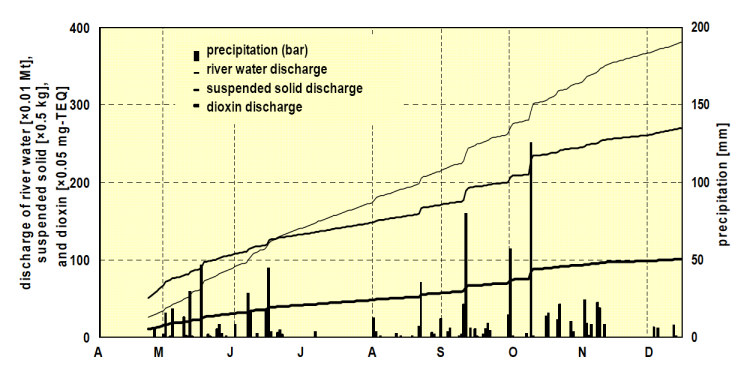
of dioxins in drainage water at the outlet of the experimental paddy
fields related closely to that of suspended solids (SS) in puddling
and successive transplanting from April until December (Fig.
1).
The application of calcium chloride as a flocculating agent was effective
in reducing the SS concentration in suspension and the dioxin outflow
from the paddy fields. (Research period: 1999-2003)
|
| 3.
|
A Research Project on the Technological Development for the Risk assessment of Cadmium Contamination in Staple Crops in Terms of Cd Concentration in Farm Soils
|
|
The project, composed of the following four major topics, started
in FY 2002 and would end in FY 2004: 1) Methodology development for
the determination of bio-available cadmium in arable soils and its
in-situ verification, 2) Determination of soil physico-chemical properties
related to cadmium contamination in the mandate staple crops, 3)
Elucidation of cadmium budget in farmland, and 4) Differences in
cadmium absorption capacity in the cultivars of rice, soybean and
spinach.
First, the relationship between cadmium absorption by rice and other
relevant field crops and the chemical forms of cadmium existing in
arable soils is statistically analyzed, and the relevant soil factors
affecting the bio-availability of cadmium are determined. After an
on-site verification testing of the method developed, a new method
is proposed for the bio-available cadmium determination. Cadmium
load to farmland from drainage water, and chemical and organic fertilizers
are analyzed to evaluate the cadmium budget in a model area. In addition,
the Cd accumulation will be successively surveyed for a long-term
application field of chemical as well as organic fertilizers. Finally,
the promising cultivars of mandate staple crops possessing a low
cadmium absorption capability are to be identified.
|
| 4.
|
A Research Project on the Development of Cadmium Uptake by Relevant Staple Crops from Cd-contaminated Farm Soils
|
|
The Codex Committee on Food Additives and Contaminants (CCFAC) has
been elaborating to set up a new standard of cadmium in foods. To
cope with a new standard of Cd under discussion in CCFAC, the Ministry
of Agriculture, Forestry and Fisheries (MAFF) has launched a couple
of projects to minimize the cadmium contamination to relevant crops,
and the National Institute for Agro-Environmental Sciences (NIAES)
has organized a research consortium to develop promising technologies
for the reduction of Cd contamination in mandate crops.
There are three major topics in this project: 1) Development of
promising cultural practices for the reduction of Cd uptake by staple
crops, 2) Establishment of soil amendment technology to effectively
reduce Cd uptake by staple crops from contaminated soils, 3) On-site
verification of the technologies developed for the reduction of Cd
uptake by staple crops.
The project started in FY 2000 and finished in FY 2002. Promising
technologies have been developed to effectively reduce Cd content
in edible parts of staple crops. The Cd content in rice grains could
be substantially decreased by water-submergence of the paddy field
three weeks before and after the heading time. More than 25 cm-placements
of non-contaminated soils on the contaminated soil layer effectively
decreased Cd content in rice grains for more than 25 years. Applications
of various agricultural materials for the amendment of soil pH, and
physical as well as chemical soil properties slightly decreased the
Cd content, but this effect could be doubled in combination of with
water management.
|
| 5.
|
Establishment of an AsiaFlux Network and Its Operation for Carbon Sequestration Estimation in the Eastern Asian Monsoon Ecosystems
|
|
The present project aims to quantify the spatial and temporal distribution
of biospheric sources and carbon sinks on a regional and global scale
and to understand the factors that regulate net sequestration of
anthropogenic carbon dioxide through biospheric processes especially
in East Asia. The present project also coordinates the establishment
and operation of a global network through the activities of regional
networks. Discussions expected in this research will contribute to
the promotion of the Third Conference of the Parties (COP3) agreement
that each country can begin consultations on the estimation of all
greenhouse gasses budgets and the converted amount in terms of carbon
dioxide in various land ecosystems.
Broadleaf deciduous and coniferous forests are the major vegetative
constituents in East Asia. The calculated annual value of net ecosystem
production (NEP) by the tower flux measurement showed that the variation
in the annual NEP seemed to closely relate to the seasonal variations
among the years rather than the annual mean of the meteorological
elements. Rice paddy fields are also one of the typical agricultural
ecosystems in Monsoon Asia. Among them, single rice cropping paddies
that dominates in northeastern Asia are characterized by two contrasting
periods, a flooded growing period and dry fallowed period which lasts
two thirds of a year. From the analyses using stable isotopes of
water and carbon, the largest carbon input was CO2 fixation by photosynthesis
of rice, where 64-65% of the fixed carbon was harvested in autumn.
Inflow and outflow of dissolved carbon accounted for 5-9% of the
total input and output (Fig. 1).
In addition, objectives related to data acquisition and its quality
control were arranged to unite the fragmented flux observation activities
in East Asian ecosystems, and to promote establishing an integrated
database of observation data. The improved Eco-DB was set up at several
participating sites and now being operated, which was the first in
flux network (FLUXNET) community and showed one of the directions
of how to share observation data (Fig.
2). We also collaborated with
other database systems and showed the locations for the observation
data on the AsiaFlux homepage.
|
|
|
|